

Your New SEO Problem Isn’t Ranking. It’s Whether AI Understands Your Business.
BRAINJAR MEDIA·
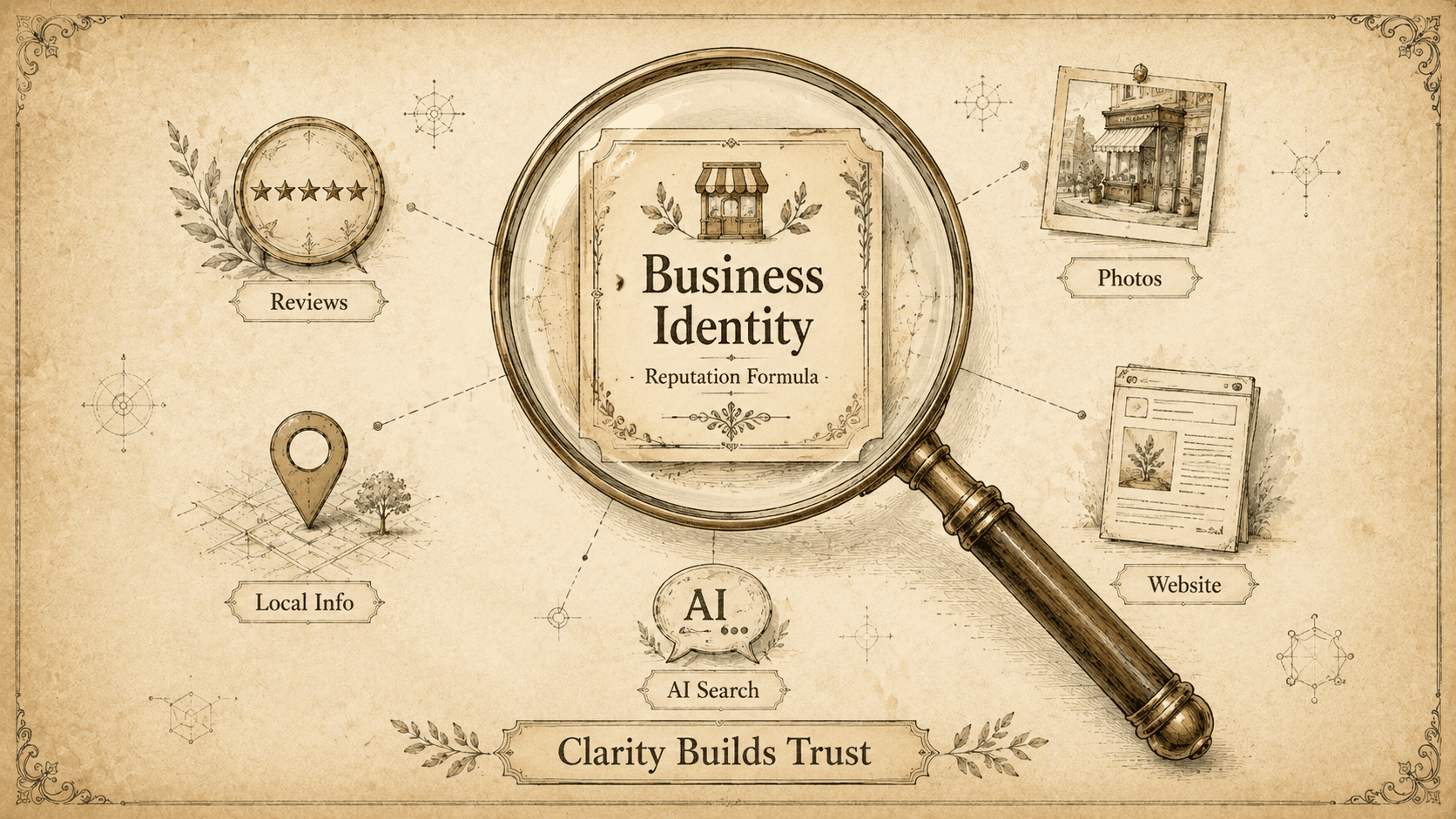
Your New SEO Problem Isn’t Ranking. It’s Whether AI Understands Your Business.
For years, businesses worried about one question:
Can Google find me?
Then the question became:
Can Google rank me?
Now we may be entering a more uncomfortable phase:
Does Google actually understand my business correctly?
That matters because Google is increasingly doing more than pointing customers toward information. Its AI features can synthesize information from websites, reviews, forums, business profiles and third-party sources into a single confident-sounding answer.
And sometimes that answer is wrong.
In this article, we’ll look at why SEO is increasingly overlapping with reputation management, what Google itself says matters in AI search, and why one of Brainjar Media’s oldest marketing principles—consistently educating the internet about who you are—may be more valuable than ever.
The Old SEO Myth: Ranking Was the Finish Line
Traditional SEO was relatively easy to visualize.
Someone searched for “physical therapist near me,” “Portland remodeler” or “best commercial cleaning company.”
Google displayed a list.
Our job was to help the right business appear higher in that list.
That job still matters.
But AI search adds another layer. Google can now summarize what it believes about a company before someone visits the company’s website.
A recent Business Insider investigation documented small businesses whose Google AI Overviews confused them with similarly named companies, surfaced outdated information or attributed complaints to the wrong business. One property-management company was reportedly mixed together with businesses in other states. Read Business Insider’s reporting on AI Overviews and small businesses.
That changes the problem.
It is no longer enough for Google to know that you exist.
Google needs enough consistent information to know which business you are and what is true about you.
The New Truth: SEO Is Starting to Look Like Reputation Management
Google’s AI systems do not learn about your company from your homepage alone.
They can encounter your website, Google Business Profile, customer reviews, old articles, videos, directories, forums and other pages discussing your brand. Google specifically notes that its generative search systems may surface what is being said about products and services across blogs, videos and forum discussions. Google explains how generative AI search uses information across the web.
That means inconsistent information creates ambiguity.
Your website says one thing.
An old directory says another.
A five-year-old review mentions a service you no longer provide.
Your About page barely explains what makes you different.
Then we ask an AI system to assemble all of that into one answer.
What could possibly go wrong?
What the Current Data Tells Us
This is not simply an SEO industry theory. The technology and Google’s own reporting are moving in this direction.
Google launched dedicated Generative AI performance reports in Search Console in June 2026. Website owners can now see impressions, pages, countries, devices and dates associated with visibility in AI Overviews, AI Mode and other generative-search experiences. Read Google’s announcement.
Google says traditional SEO fundamentals still apply to AI search. Its current guidance specifically recommends valuable, non-commodity content, clear technical structure, local business information, and high-quality images and video rather than some completely separate magical AI optimization formula. Read Google’s generative AI optimization guide.
AI summaries are not perfectly reliable. A 2026 academic study analyzing more than 98,000 individual claims in Google AI Overviews found about 11% were unsupported by the pages cited alongside them. Read the research on Google AI Overview claim fidelity.
So the emerging SEO question is not simply:
“Are we visible?”
It is:
“What conclusion is the machine reaching about us?”
Brainjar Has Been Working on This Problem for Years
This sounds new.
The technology is new.
The marketing problem is not.
Reputation management has always been a pillar of Brainjar Media’s approach to SEO and content.
Our job has never been simply to place keywords onto pages.
We have spent years helping Google understand:
What a client actually does
Which products or services matter most
Where the business operates
What makes it different
Which customer questions it is qualified to answer
What evidence supports its expertise and reputation
We reinforced those ideas through websites, service pages, blog content, Google Business Profiles, reviews and other consistent signals.
Five years ago, we called that good SEO.
Today someone will probably invent a three-letter acronym for it and sell a webinar.
Consistency Reduces Ambiguity
The practical response to AI search is surprisingly unglamorous:
Make the internet’s description of your business unusually consistent.
Your website should clearly explain your services.
Your Google Business Profile should reinforce them.
Your About page should explain who you are.
Your reviews should contain genuine customer experiences.
Your blog should demonstrate expertise rather than merely announce that you possess it.
Your images, videos, service descriptions and authoritative third-party mentions should keep telling roughly the same story.
This does not guarantee that an AI system will never make a mistake.
It gives the system fewer opportunities to misunderstand you.
We’ve seen this work in practice. Brainjar helped All About Automotive build authority through consistent, useful automotive content rather than simply chasing rankings. The result was a 200% increase in organic traffic and recognition for its blog—years before anyone was talking about AI citations. See the All About Automotive case study.
What Does Google Think Your Business Does?
Search your company. Ask AI tools about it. Ask the questions a potential customer might ask.
Then compare the answer with reality.
If Google or AI is confused about your services, reputation or competitive difference, that confusion is now a marketing problem.
Contact Brainjar Media, and we can help identify where your online presence is sending mixed signals and strengthen the content that explains who you really are.
The Technology Changes. The Fundamentals Don’t.
Brainjar has been through search, social media, mobile, voice search and now generative AI.
Every new technology produces a temporary panic that marketing has fundamentally changed.
Usually, the technology changes how information is delivered.
The fundamentals remain remarkably stubborn.
Be clear.
Be useful.
Be credible.
Give customers—and the systems helping those customers—enough evidence to understand why your business deserves attention.
That was good marketing before AI.
It may be even more important because of AI.
Contact Brainjar Media and let’s make sure the internet understands your business before it starts explaining your business for you.
Your Google Business Profile Isn’t Sending People to Your Website Anymore. That’s the Point.
READ ON →Your Best Competitor May Be 2,000 Miles Away
In this article, we’ll explain why competitor research should include both local and national businesses,
READ ON →We Were Optimizing for AI Before AI Search Existed
Every few years, marketing discovers a new technology, invents several acronyms and announces that everything we did yesterday is obsolete.
READ ON →