
Your Google Business Profile Isn’t Sending People to Your Website Anymore. That’s the Point.
BRAINJAR MEDIA·
For years, local SEO had a simple goal:
Get found on Google, earn the click, send the customer to your website.
That journey is changing.
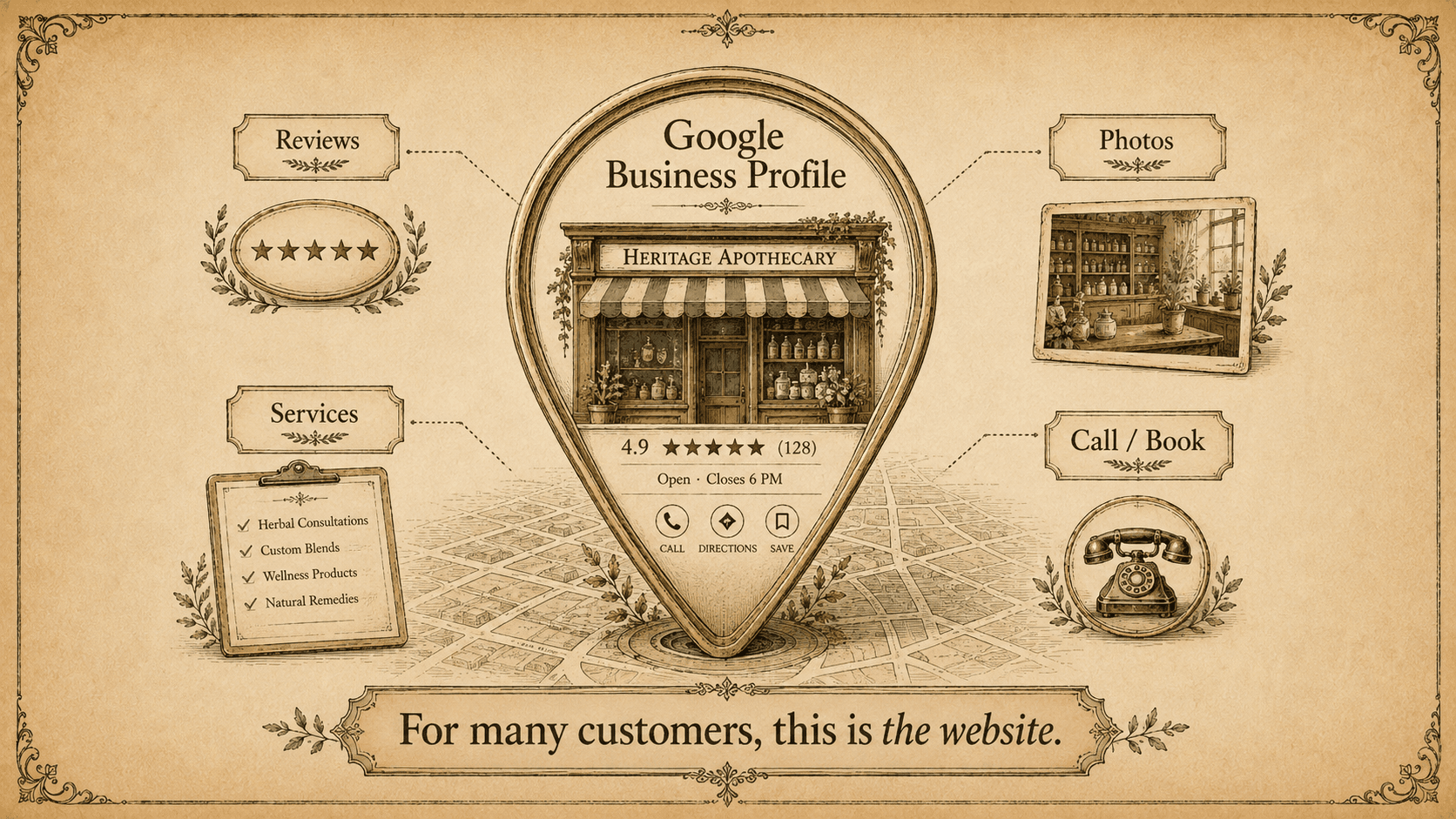
Increasingly, customers can see your reviews, photos, services, hours, directions, phone number, business description and other decision-making information directly inside Google Maps or your Google Business Profile.
Sometimes they never need to visit your website at all.
That sounds alarming until you realize what it actually means:
Your Google Business Profile is no longer just a doorway to your website. For many customers, it is the website.
In this article, we’ll look at why Google Maps is becoming a destination instead of a referral source, what recent data says about local-search behavior, and why Brainjar Media has treated Google Business Profiles as serious marketing assets for years.
The Old Myth: Your Google Business Profile Exists to Generate Website Clicks
The traditional local-search journey looked like this:
Google → Website → Research → Call or Book
So marketers naturally measured success by clicks.
More website visits meant the listing was working.
That is becoming an incomplete way to think about local SEO.
Google Business Profiles now contain enough information for many customers to make a decision without leaving Google.
A customer can compare ratings, read reviews, look at photos, examine services, check hours and determine whether a business is nearby.
Then they can call, request directions or make another decision directly from Google.
The website may never enter the process.
That does not necessarily mean the marketing failed.
It may mean Google finished the job.
The Current Truth: Google Maps Is Becoming the Destination
New Google Business Profile performance data supports that shift.
A recent analysis found that U.S. Google Business Profiles saw:
Website clicks fall 12.5% year over year
Calls fall 11.9%
Direction requests increase 21.1%
Mobile Maps impressions increase 30.4%
The researchers concluded that customers appear to be completing more of their journey inside Maps itself rather than using Google primarily as a stepping stone to another website. Read the Search Engine Land analysis of Google Maps behavior.
That makes intuitive sense.
If someone searches for a coffee shop, dentist or auto repair company, they may not need a 12-page website tour.
They want to know:
Are you nearby?
Are you open?
Do you provide the service I need?
Do people trust you?
What does the place look like?
How do I get there?
Google can answer most of those questions before the click.
Google Already Treats Your Profile Like a Storefront
Google itself now describes the Business Profile as a “local storefront on Google Maps & Search.”
A Business Profile can display location, contact information, hours, photos, reviews and website information directly inside Google. Read Google’s description of Business Profiles.
That phrasing matters.
A storefront is not merely a sign pointing somewhere else.
It is part of the customer experience.
And Google is increasingly assembling that experience using information from multiple sources, including business-provided data, websites, third-party information and customer contributions such as reviews and photographs. See how Google sources Business Profile information.
The result is something very similar to the AI-search trend we have been discussing.
Google is not simply finding your business.
It is interpreting and presenting your business.
What 1.8 Million Google Business Profiles Tell Us
A recent Whitespark study examined 1.8 million Google Business Profiles across 4,209 business categories.
The findings reinforce how much profile details matter.
Businesses using a specific primary category generally ranked better than businesses using adjacent or more generic categories.
Relevant additional categories were associated with stronger local visibility.
Businesses in highly competitive industries tended to have more complete profiles.
Profiles containing key information such as hours, photos, descriptions and verification correlated with stronger local rankings.
Read the analysis of the 1.8 million-profile study.
Google’s own guidance says essentially the same thing: complete and accurate information improves the likelihood that a business will appear for relevant local searches. Read Google’s local-ranking recommendations.
None of this requires a secret SEO trick.
It requires being very clear about what your business actually does.
Local SEO Is Becoming Reputation Management Too
This connects directly to another shift we have been watching.
AI search is making businesses think harder about whether Google understands them correctly.
Google Maps does the same thing at the local level.
Your categories tell Google what kind of business you are.
Your services tell Google what you actually provide.
Your reviews describe customer experiences.
Your photographs provide visual evidence.
Your hours, attributes and location information establish whether you are a practical match for the customer.
Together, those details create a description of your business.
The more accurate and consistent that description becomes, the easier it is for both customers and Google to understand why you belong in the result.
Your Google Business Profile Needs to Be Treated Like a Website
That means local businesses should stop treating GBP optimization as administrative housekeeping.
The practical checklist is straightforward:
Choose the most precise primary business category available.
Add relevant secondary categories without stuffing unrelated ones.
Complete your services or products.
Keep hours and business attributes current.
Upload strong, recent photography.
Encourage real reviews that naturally describe the service customers received.
Keep information consistent with your website and other major listings.
Google even notes that individual services added to a Business Profile may be highlighted when customers search for those offerings. Read Google’s guidance on Business Profile services.
Every one of those fields helps answer a customer's question before they ever reach your site.
Brainjar Has Been Treating the Map Pack This Way for Years
This is not a new direction for Brainjar Media.
Our Local SEO service has always treated Google Business Profiles, Maps visibility and local listings as part of the core search strategy—not an optional add-on.
A good example is Café Delirium.
Brainjar helped the neighborhood coffee shop become highly visible in Gresham coffee searches, precisely the kind of local discovery where the map results can determine which business someone visits next.
See Café Delirium and other Brainjar SEO work in our portfolio.
The goal was never simply to manufacture a website click.
The goal was to make sure the customer found the right business.
Your Website Still Matters. Its Job Is Changing.
None of this means websites are becoming irrelevant.
Customers with larger purchases, complicated questions or longer consideration cycles will still want deeper information.
Your website is also one of the sources Google can use to understand your business.
But for many local searches, the website may increasingly become the deeper layer rather than the first stop.
Google discovers.
Maps qualifies.
Your website provides depth when the customer needs it.
The fundamentals still hold.
Be accurate. Be clear. Build trust. Make it easy for customers to understand what you do and why they should choose you.
The technology simply keeps finding new places to display that information.
Contact Brainjar Media, and we’ll help make sure your Google Business Profile, website and local search presence all tell the same convincing story.
Your New SEO Problem Isn’t Ranking. It’s Whether AI Understands Your Business.
Your New SEO Problem Isn’t Ranking. It’s Whether AI Understands Your Business. For years, businesses worried about one question: Can Google find me? Then the question became: Can Google rank me? Now we may be entering a more uncomfortable phase:
READ ON →Your Best Competitor May Be 2,000 Miles Away
In this article, we’ll explain why competitor research should include both local and national businesses,
READ ON →We Were Optimizing for AI Before AI Search Existed
Every few years, marketing discovers a new technology, invents several acronyms and announces that everything we did yesterday is obsolete.
READ ON →