AI Is Changing the Click: Your Website Visitor May Already Be a Lead
BRAINJAR MEDIA·
For most of the internet’s history, we treated a website visit as the beginning of the sales process.
Someone searched Google, clicked your website and started figuring out whether you could help them.
AI may be quietly reversing that order.
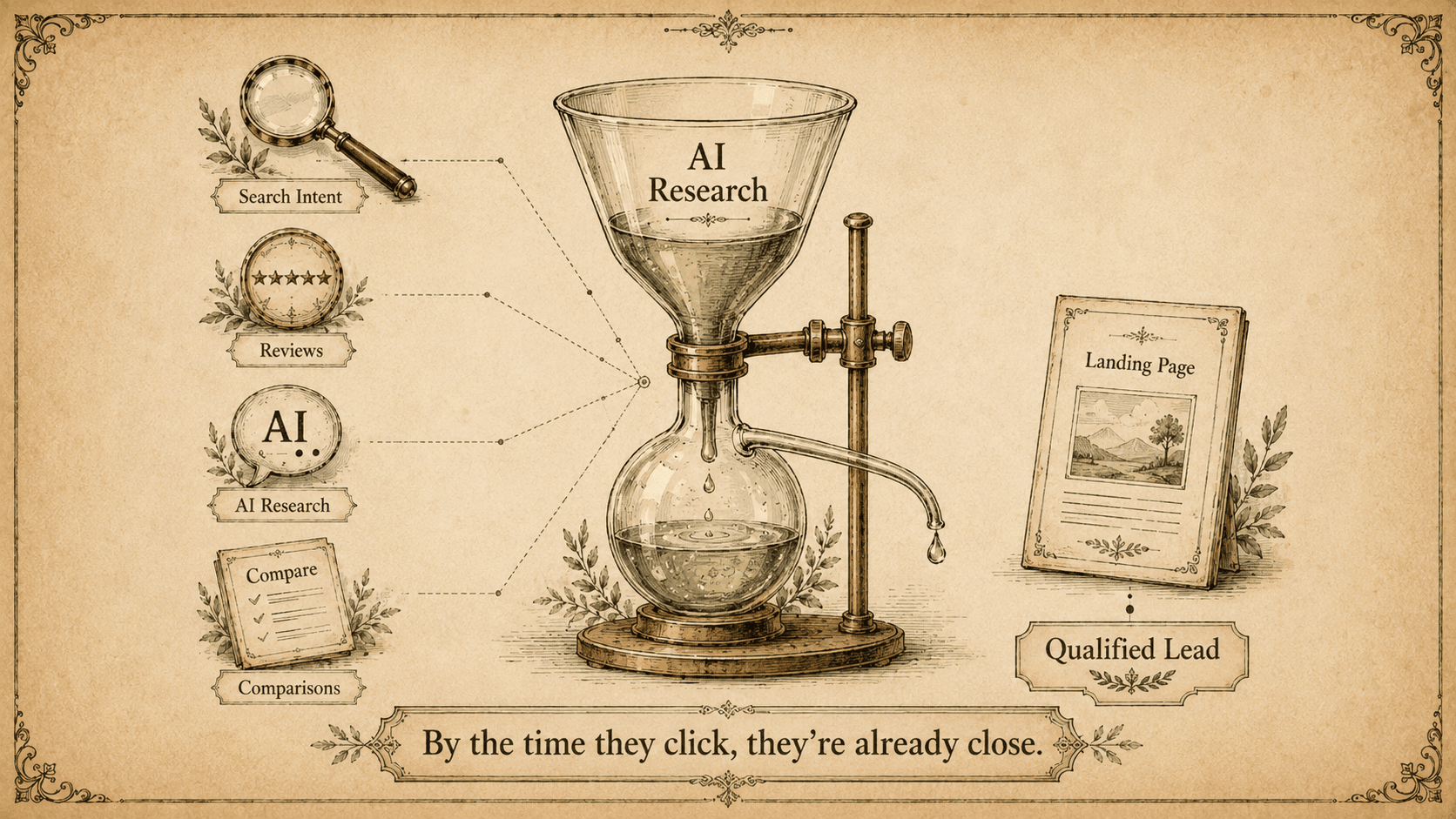
A customer can now spend ten minutes explaining a problem to ChatGPT, comparing alternatives, rejecting options, asking follow-up questions and narrowing down exactly what they want before you ever know they exist.
Then they click your website.
That person is not necessarily a tire kicker anymore.
They may already have you on the shortlist.
In this article, we’ll look at new data showing how AI is changing pre-click research, why Google search is not disappearing, and why Brainjar Media builds landing pages specifically for visitors who may arrive ready to make a decision.
The Old Myth: The Website Starts the Research
The traditional customer journey looked something like this:
Search → Website → Research → Compare → Contact
That assumption shaped websites for decades.
Homepages introduced the company. Service pages explained what it did. Visitors wandered around collecting enough information to decide whether they were interested.
AI can compress much of that research into the period before the click.
A customer might ask:
Who provides this service near me?
Then:
Which one specializes in my particular problem?
Then:
What are the differences between these three companies?
Then:
Which one has better reviews?
By the time the AI provides a link, that customer may already understand the category, know the alternatives and have eliminated several competitors.
Your website is no longer giving the first impression.
It may be giving the final confirmation.
What the New Data Shows
Shopify’s recent commerce data gives us one of the clearest early looks at this behavior.
AI-referred sessions grew 197% year over year in Q2 2026.
Organic-search sessions still grew 12% on a much larger base.
Organic search continued sending Shopify merchants more traffic than all tracked AI platforms combined.
In research-intensive product categories, AI-referred shoppers converted at roughly twice the rate of organic-search visitors.
Read Shopify’s analysis of how AI and organic search are performing different jobs.
Earlier Shopify data found AI-referred product-page visitors converting nearly 50% better than organic-search visitors, while orders carried a 14% higher average value. More than half of AI-referred sessions began directly on product pages, versus about 20% of organic sessions.
Again, these are ecommerce numbers, not a promise that every plumber, attorney or consultant will see identical results.
What matters is the behavior behind them.
AI appears capable of doing some of the comparison work before the visitor arrives.
AI Isn't Replacing Google. It's Changing What Happens Before the Click.
Everyone keeps asking whether AI will replace Google.
Shopify’s data suggests that may be the wrong question.
Organic search is still growing and remains vastly larger. AI referrals are growing much faster, but the channels appear to be performing different jobs.
A useful way to think about it is:
Google discovers. AI deliberates. Your website closes.
That journey will not describe every customer. People will move between Google, AI, reviews, social media and websites in different orders.
But it gives small businesses an important clue.
The website visitor may increasingly arrive after substantial research instead of before it.
And that changes what the page needs to accomplish.
Why Brainjar Builds Landing Pages for This Moment
Brainjar has never believed every visitor should be dumped onto a homepage and told to figure it out.
We build landing pages around search intention.
If someone searches for a particular problem, service or need, the page they reach should immediately confirm:
Yes. You are in the right place. We understand the problem you are trying to solve. Here is why we're qualified to solve it. Here is what happens next.
That becomes even more important when AI has already helped the customer narrow the field.
A high-intent visitor does not need another generic introduction to your company.
They need confirmation.
They need proof.
They need the last unanswered question removed.
And they need an obvious next step.
Brainjar’s content-marketing work explicitly includes service and landing-page copy designed to help pages both rank and convert. See how Brainjar approaches content marketing and landing-page copy.
Your Traffic May Be Smaller—and More Valuable
This shift also complicates an old marketing obsession:
More traffic is always better.
Not necessarily.
If customers can conduct more preliminary research without visiting websites, some low-intent visits may disappear.
But the people who do arrive could be considerably more qualified.
That makes conversion rate, calls, bookings and actual customers increasingly important measurements alongside raw traffic.
The click itself may become harder to earn.
But the click you receive may mean more.
We've Already Built Websites This Way
Brainjar’s work for Tiki Pets is a useful example.
Shoppers needed to evaluate premium pet food, understand its quality and determine where they could actually buy it.
We built the website so visitors could examine searchable product information and nutrition details, then immediately use a store locator to find the nearest retailer.
In other words, the website did not just provide information.
It helped an informed shopper finish the decision.
That philosophy predates generative AI.
The technology changed.
The customer still needs a clear path from “I think this might be right” to “here's what I do next.”
Is Your Website Ready for a Visitor Who Already Did the Research?
If AI increasingly handles part of the research and comparison process, your website cannot behave like every visitor just walked through the front door knowing nothing.
Some of them may arrive almost ready to buy.
Your landing page should respect that.
Answer the remaining questions. Demonstrate why you are different. Provide evidence. Remove friction. Make the next action unmistakable.
Contact Brainjar Media, and we'll help build the search content and landing pages that turn increasingly informed visitors into customers.
The fundamentals have survived another technological revolution.
People still research.
People still compare.
People still need confidence before making a decision.
AI may simply be moving more of that process to somewhere you cannot see.
By the time they reach you, don't make them start over.
Your Google Business Profile Isn’t Sending People to Your Website Anymore. That’s the Point.
READ ON →Your New SEO Problem Isn’t Ranking. It’s Whether AI Understands Your Business.
Your New SEO Problem Isn’t Ranking. It’s Whether AI Understands Your Business. For years, businesses worried about one question: Can Google find me? Then the question became: Can Google rank me? Now we may be entering a more uncomfortable phase:
READ ON →Before You Hire Someone to Do Google Ads, Understand What You Are Buying
Before hiring anyone to run Google Ads, you should determine whether paid search is actually the best use of your marketing budget—or merely the most obvious one.
READ ON →